Warning: this post is a rant about Albertan and Canadian politics! If you hate politics, leave now while you still can!! 🙂
The point of this (very long-winded) article is to a) provide my take on the few and very weak arguments for, and many and very compelling arguments against, my home province of Alberta separating from Canada, and hence b) recommend that we Albertans vote to stay in Canada. I also recommend ‘no’ to the nine other questions, but I’ll leave those to focus on Canada.
I normally keep my political views in the safe confines of beer-fueled debates with friends, and well away from my company blog and SM streams. However, since a) I love my country, Canada, b) this political issue will have colossally negative impacts to business and to all other areas of our daily life for decades to come if we vote to separate, and c) the behaviour of our provincial government has been abysmal as regards this issue, I feel it’s time to pipe up and subject you all to my pedestrian scholarship on the matter! 😉 I will use my limited reach to also provide my personal interpretations of various facts below, because businesses are for, run by and employ humans, after all, not for bots that spread disinformation, nor for the unscrupulous bottom-dwellers behind the bots who enrich themselves by stirring the pot with this garbage and watching us fight.
Biases. Let me start by confessing my biases. I love my country, have since I was a tot, and would qualify myself as a patriot. Not the fake kind that claimed it with a Canadian flag and “true patriot!” placard on their pickup truck during Covid, but rather the real kind that buys Canadian, loves all areas and people of our country equally, and is Canadian first, from a province second. I grew up in Ontario, moved to Alberta by choice in the 90s, and have been here ever since (other than a quick 2 years in the UK). I lean centre left in the Canadian voter context (or radical communist in the US ;-).
Back to the point of Alberta separation. So, what are the arguments for separation?
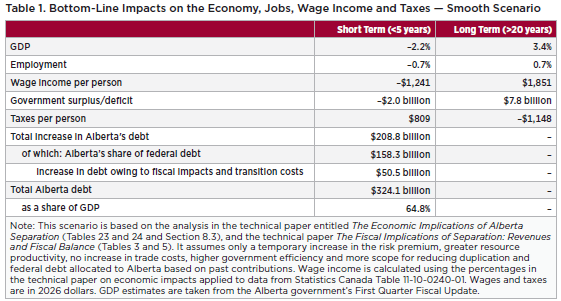
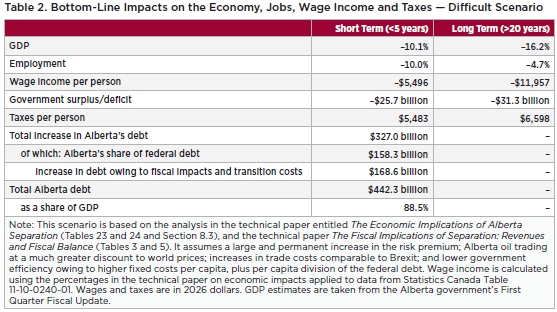
- Financial gain. In the best-case ‘smooth’ economic scenario (unlikely, IMO), modest salary losses of ~$1200/yr in the first 5 years, and modest gains of ~$1800/yr, after ~20 years of considerable costs and deficits to build all the necessary infrastructure to run the federal institutions required to truly be a country. N.B.: you have to ignore the worst-case ‘difficult’ scenario altogether, which seems far more probable, IMO (more later).
- Self determination. The notion that Albertans would be captains of their own ship, able to make their own decisions, and create their own paradise without all the ‘bad’ choices made by the federal government. The power to choose is real, but the paradise is a whopper of a delusion at best, IMHO.
- Getting the last word. The emotional ‘win’ of turning their back on the rest of the country and telling the federal government to get stuffed. I’m guessing this is a big deal for many in the separatist movement, but I don’t know that.
- Perhaps others, but you should consult separatist info sites, since the reasons don’t stick when I hear them.
And what are the arguments against separation? Oh my, where to start?
- New pipelines if we stay, but not if we go. While many Albertans justifiably complain that former Prime Minister (PM) Trudeau’s environmental controls did hinder investment in the oil patch, his government did fund a pipeline through BC — against BC’s wishes — that is now in use. The federal government was able to force it through BC by declaring it to be ‘in the national interest’; the BC government fought and lost in court trying to oppose it.
- Recently, PM Carney’s government has agreed to approve and also help fund another pipeline through BC, which BC begrudgingly accepts because it has again been declared to be in the national interest.
- In the event that Alberta separated, this national interest argument would instantly evaporate, as would any chance of building a new pipeline out of Alberta through BC or the rest of Canada, at least on anything resembling favourable terms. I would imagine that tolls would apply to any existing pipeline exports. Any growth opportunities would have to be negotiated with the US, which is not a favourable negotiating position for Alberta to be in the current American political climate for obvious reasons; expect a serious price squeeze.
- Independence likely means joining the US. In my view, it is a forgone conclusion that Alberta independence would be short-lived. Alberta would be land-locked, with the rest of Canada treating it as any other foreign competitor (but with much more spite), and working hard to ensure that any new trade deal was advantageous to Canada. Alberta would be heavily dependent on the US for oil sales that would likely be even more discounted by the US than they are now, given Alberta’s lack of options for customers.
- This is in contrast to the fair market oil prices on offer with the last and next pipelines to the Pacific, opening up the Asian market for Alberta; likewise for “Energy East”, were it to materialise.
- The economic pain inflicted on Alberta would likely force it to join the US in, say, 5-10 years (my WAG), to avoid the government equivalent of bankruptcy, IMO.
- Even the separation movement leaders don’t think this is about independence. The separatist leaders appear to be disingenuous when they refer to “independence” as their goal; many realise that Alberta would be forced to have a closer relationship with the US if we leave Canada, and openly discuss courting the US for an alliance of some sort, possibly including statehood, and have gone so far as to discuss offering our oil and water resources to the US. As an aside, they have no mandate to a) have such discussions or b) make any kind of offer, so this sounds very much like treason to me, but I’m not a lawyer.
- Exchanging our Canadian compassion and social safety net for guns and right-wing nonsense. The separatist vision for an “independant” Alberta is very different from the province we currently live in, and much more like a Republican American state, from what I can tell. The separatist “Alberta Prosperity Project” has created a 54 page draft constitution, the “Foundation of Freedom”. I had to stop reading several times to have a laugh; it’s like it was written by Yosemite Sam! But really, it’s not funny, it’s scary, if you like our Canadian ‘way of life’. Here are some legal/policy highlights, together with my informal interpretation of the meaning/ramifications.
- Rights & Freedoms, Article 6: the right to bear arms, open or concealed. This looks like the fast track to downgrade to the US’s much higher crime rate, school shootings, crowed jails, … fantastic! Why??? Of the many things the US does well, managing or preventing gun crimes is not on the list.
- Rights & Freedoms, Article 8: parental authority over upbringing, education and healthcare of their kids. This sounds to me like code for ‘you can hit your kids, sex ed is heterosexual only, and no vaccines, even in a pandemic’. Bring on the measles and Ebola!
- Restraints on Government, Article 5.1 c): government shall not regulate or fund the media. This sounds like no public broadcaster (like the CBC), and no telling Facebook or Twitter to stamp out lies, misinformation, hate speech, etc..
- Restraints on Government, Article 5.1 d): no cartels, boards or organisations that limit choice in the economy/trade. So no wheat or dairy boards, supply management, etc., just let the American and other multinationals flood the market; good bye to many Albertan farm businesses.
- Treaties and Boundaries, Article 4: full recognition of Treaties 6, 7 and 8, but ‘as written’. I would worry that this reverts back to the original texts of these treaties with indigenous people, meaning all land is ceded to the crown, vs. later court interpretations that allow for the aboriginal interpretations of these treaties in their verbal histories, e.g. that only the top surface of the land, as for crops, was ceded.
- Financial Limits of the State, Article 1.2: personal, business and consumption taxes capped at 10% each. I believe this would place the government at a significant disadvantage financially vs. current taxation levels, which might spell the end or serious erosion of healthcare, education, etc.
- Economically, things are likely much better if we stay, and much worse if we leave Canada.
- The Business Council of Alberta says that, while changes are needed in Alberta’s relationship with Canada, the best path forward is by staying in Canada.
- A University of Calgary report on the economic and fiscal implications of separation, commissioned by the province, gave two scenarios, “smooth” and “difficult”, depending on how negotiations proceed with the rest of Canada; their summary tables for each are shown at the bottom of this post. The ‘smooth’ scenario says GDP and salaries go down for the first 5 years by ~2.2% and $1200, and up after *20* years by 3.4% and $1800; the ‘difficult’ scenario projects GDP and salaries go down for the first 5 years by ~10.1% and $5500, and down after *20* years by 16.2% and $12,000. So, lose, and then lose a bunch more.
- Given the tremendous negative impact of breaking up the country on the rest of Canada, I would bet heavily on the difficult scenario, and expect every impediment to Alberta’s progress to materialise.
- The task of transitioning from a province to a country is enormous, risky, and would take decades.
- The Alberta Transition Plan, with Keith Wilson as a lead author, appears to me be a fairly thorough and thoughtful look as what is involved in this transition. In many cases, a statement akin to ‘these details will become clearer later on’ is used understandably, but to me this just highlights the enormity and complexity of the task. The document really brought home for me a) the colossal risks being contemplated, and b) just how much of a enormous and lengthy distraction separation would be. We see shortcomings today in the funding and attention given by our provincial government to (what should be) it’s current priorities, e.g. education, healthcare, roads, etc. Now, imagine adding a huge burden to *create* a bunch of new federal institutions to replace the ones being lost, AND that the tax cap of 10% is in place, AND that we are now saddled with paying our share of the federal debt to Canada.
- The separatist leadership has a number of questionable people at the helm.
- Jeffrey Rath, co-founder of the separatist “Alberta Prosperity Project” (APP) is accused of stealing millions of dollars from a) the Tallcree first nation, and b) US lenders.
- Dennis Modry, co-founder and former CEO of the APP, was found to have misappropriated $1.3M from his aunt and uncle who have Alzheimer’s and dementia, and was ordered to pay the money back with interest by a BC court. I believe he has yet to do this.
- Keith Wilson may have sinned like the rest of us, but I haven’t heard anything egregious. He is educated and thoughtful, spoke well at the debate with Jason Kenney hosted by the Aristotle Foundation, and wrote eloquently and clearly as a principal author of the Alberta Transition Plan. I disagree with his conclusions entirely, but that doesn’t make him a bad guy.
- The whole referendum is an enormous and dangerous distraction, and shouldn’t have happened in the first place. It should be rejected outright by voting to stay. Our provincial government should not have put us in this place.
- A referendum on separation was never mentioned by the United Conservative Party (UCP) as being part of their platform during the last election. In my view, the citizen initiatives are fine for smaller matters like speed limits, taxation levels, MLA recalls, etc., but not something as monumental and existential as a referendum on separating and creating a new country, because … a small minority of separatists are making a lot of noise?? But by several accounts, the separatists appear to have hijacked the governing UCP with membership drives, and have acquired considerable power over the Premier, so … here we are; so said former UCP Premier Jason Kenney during the Edmonton Chamber of Commerce event with fellow former NDP Premier Rachel Notley on Tuesday Oct.13th. As Kenney pointed out, the foundation of the UCP included a declaration supporting a united Canada, so any separatist members should be shown the door, but that requires considerable rigour from the party leadership, which appears to be in short supply.
- Any legitimate separatist movement should, IMO, be required to form their own party with separation as a clear objective, and then they can go drum up the votes needed to get elected — as in Quebec. This rushed referendum bypasses the democratic process of having a lengthy and fulsome debate over such a major issue. A referendum can suffer from issues like low and/or imbalanced turnout due to factors like long line-ups caused by too many questions being asked at once … as is presently the case, with *10* questions causing very long line-ups in early voting, likely worse on voting day.
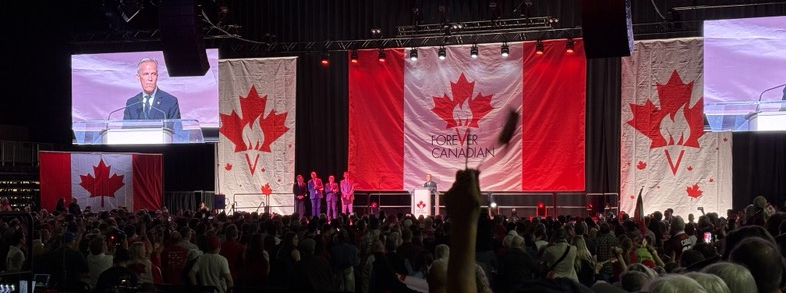
- Our Premier, Danielle Smith, talks out of both sides of her mouth. She now says that she wants Alberta to stay in Canada, yet she initially bent over backwards to accommodate the separatists in their drive to split Alberta off from Canada. The Premier created the “Citizen Initiative Act”, which required signatures from 20% of the electorate from the last election (or 355, 464 signatures) within 90 days for a petition. The pro-Canada “Forever Canadian” side worked hard to meet this target legitimately to argue that Albertans *don’t want and shouldn’t face a referendum*, and was successful. Then when the separatists wanted to initiate a referendum, the Premier made it easier for them to qualify by halving the requirement to 10%, and giving them 120 days. Stay Free Alberta met the lower threshold with their petition to have a binding referendum on separation, but this was stopped by a court challenge by several First Nations, arguing that they were not consulted, as is their right under the Canadian constitution. We are deeply indebted to them for this act! The Premier appealed this decision, but in the short-term tried again to appease her separatist voting base by creating a non-binding ‘referendum on having a later binding referendum’, which is what we’re voting on now in Alberta.
Casting my ‘true patriot love’ aside for the moment, how does separation look like the right path forward? Talk about lose-lose. It is a huge gamble with the futures of 5 million Albertans, and those of the 35 million Canadians whose country we’d be breaking, all while President Trump and his court are trying to annex/divide Canada and conquer! The best-case economic scenario for separation is possibly a shade brighter than present, while the worst-case scenario is a) more likely, IMO, and b) many shades darker, and for a long time (decades). … and for what? The ability to jump up and down and say ‘nobody tells me what to do, and now I have a gun in a holster’?? I think we’d become a US state in a hurry, with excellent Intestate highways to our beautiful mountains, no universal healthcare, a lousy education system, and lots of school shootings; our resources would be drained in a heartbeat, with nothing to show for it. No thanks.
If this transformation is what you really want, I’m not here to judge you, and the good news is you can find it just south of us. But you have to leave our province and country behind when you leave. On the other hand, if you want to keep our present values and improve things in Alberta, vote to stay in Canada, help us fend off threats on our sovereignty from Trump and others, and build and fortify our own, Canadian independence. We’re off to a good start; let’s not set ourselves back 20 years.